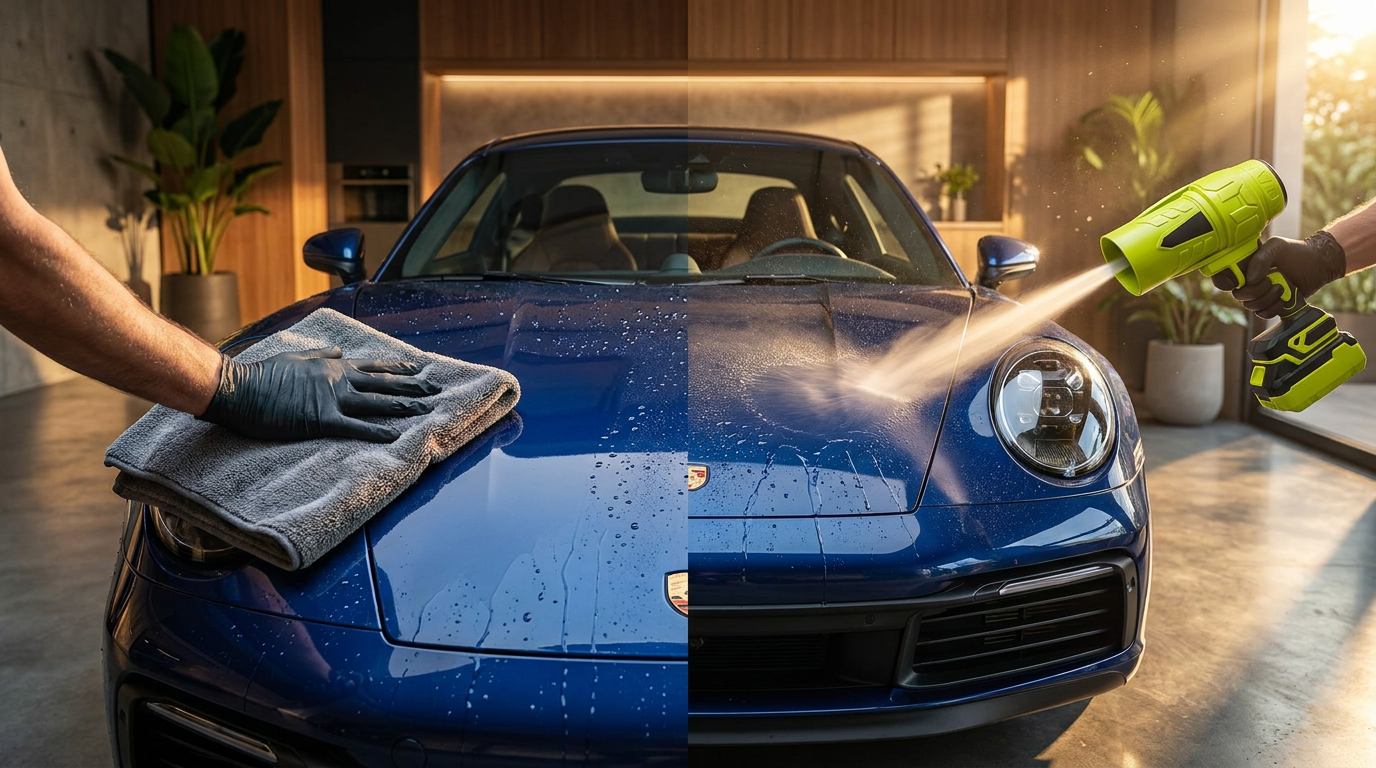
Jet Blower Drying Performance vs Microfiber Towels
 Daniel OkaforField Tester
June 17, 2026. This evaluation compares the mechanical efficiency of the Jet Blower against manual microfiber drying for automotive maintenance. It is written for vehicle owners and equipment managers seeking to reduce physical contact with sensitive finishes.
The Friction Problem in Manual Drying
I tested this for four weeks across a variety of surfaces, ranging from ceramic-coated paint to porous plastic trim. The traditional approach to drying always involves some degree of physical friction. Even the highest quality 1,200 GSM microfiber towels eventually trap particulates that can lead to micro-marring or "swirl marks" over time. According to The Rag Company, choosing between a blower and a towel is often a matter of personal preference, but they note that blowers are particularly effective at removing water from recessed areas where towels cannot reach. During my second week of testing, I noticed that while a towel might soak up surface water quickly, it leaves moisture trapped in mirror housings, window seals, and lug nut recesses. This trapped water inevitably drips out later, leaving unsightly streaks that require a second pass. What surprised me: the amount of hidden water that a standard towel simply ignores, which often leads to mineral deposits if the water is hard.
Jet Blower Efficiency and Surface Safety

Photo by Jimmy Liao on Pexels
When I switched to the Jet Blower, the dynamic of the drying process changed from absorption to displacement. I tested this for three consecutive washes on a black sedan, which is the most unforgiving color for surface defects. Here's the moment it earned its place: I was able to clear the entire front grille and the honeycomb mesh sections in under forty seconds—a task that usually takes ten minutes of tedious dabbing with a damp towel. The Jet Blower uses a high-velocity air stream to shear water off the surface. Because there is no physical contact between the tool and the paint, the risk of dragging a missed piece of grit across the clear coat is eliminated. Day three is where I noticed the cumulative time savings; I wasn't just drying the car faster, I was avoiding the laundry cycle associated with washing and drying ten to fifteen microfiber towels per week. While some users on the BMW 2-Series forum at Bimmerpost debate the merits of battery-operated blowers versus towels, the sheer portability of a hand-held jet unit allows for a level of precision that larger leaf blowers lack. What I'd do differently: I would recommend starting from the roof and working downward to ensure the air velocity pushes water toward the ground rather than swirling it back onto dried panels.
Selecting the Right Drying Methodology
Choosing between these methods depends largely on your environment and the condition of the surface. If you are working in an area with high TDS (Total Dissolved Solids) in the water, speed is your primary defense against spotting. I found that the Jet Blower is most effective when the vehicle has some form of hydrophobic protection, such as a wax, sealant, or ceramic coating, which allows the air to bead and roll the water off effortlessly. If the surface is "flat" or lacks protection, the water tends to cling, making the blower work harder. To decide which tool fits your workflow, consider this checklist:
- Assess surface protection: Is the water beading or sheeting?
- Check for intricate trim: Do you have grilles, vents, or complex wheels?
- Evaluate storage and maintenance: Do you have the capacity to properly launder microfiber?
- Consider contact risk: Is the paint soft or prone to scratching?
- Time constraints: Are you looking to finish the drying process in under five minutes?
The Jet Blower streamlines the most tedious part of maintenance while protecting the integrity of the finish. Shop Jet Blower here.
Sources
Photo by Thijs van der Weide on Pexels
- Drying Towel VS Leaf Blower!? Which One Dries You Car Better ...
- Blower vs Towel Drying Car: Which is Best? - Facebook
- Blower vs Towel: Which is the Best Way to Dry A Car After A Wash?