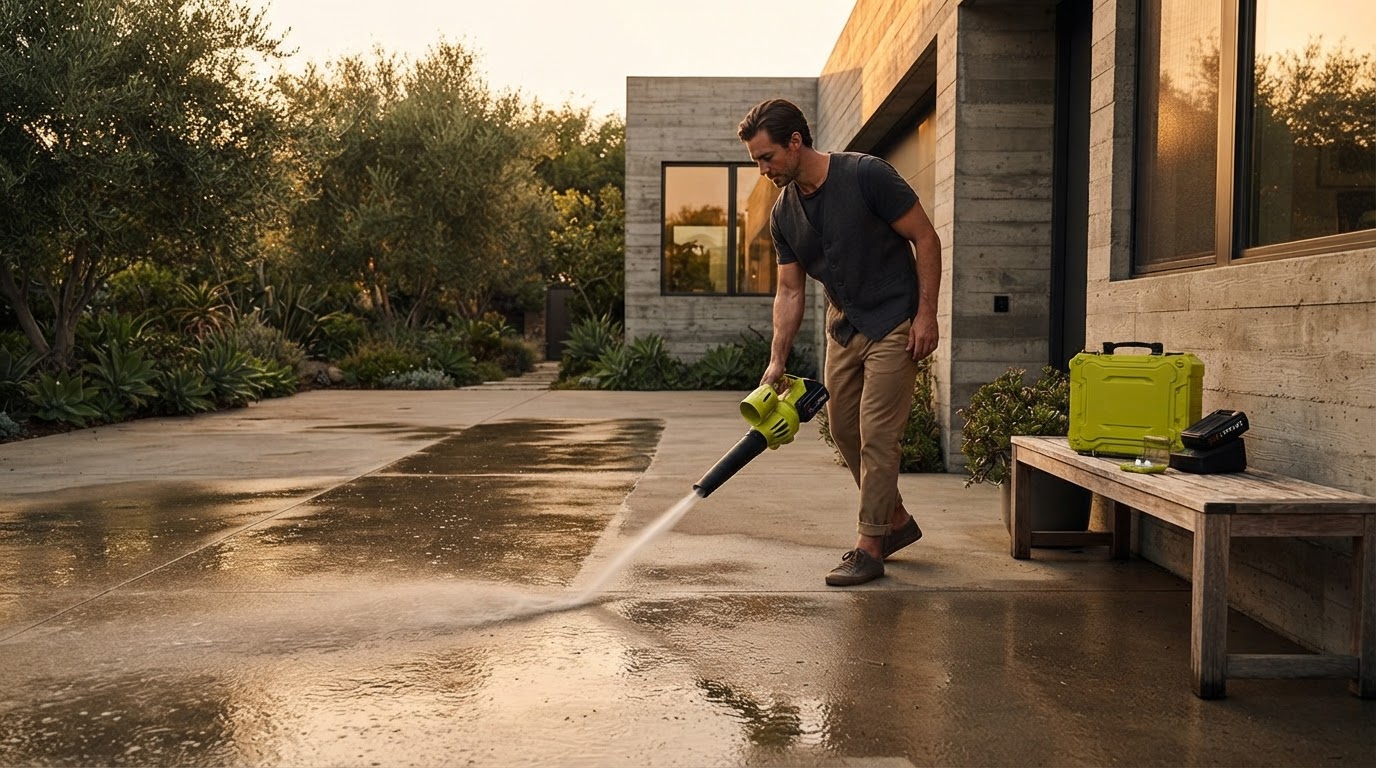
The 30-Foot Wet-Concrete Test That Changed My Jet Blower Pick
 Sam VasquezBuying Guide Lead
A wet 30-foot strip of concrete told me more about blower choice than any “CFM vs MPH” spec sheet: the jet blower cleared it in 74 seconds, while a higher-CFM axial leaf blower took 118 seconds and left a damp film.
That result is the angle most buyers miss. The question is not “Which blower has the biggest number?” It is: Which airflow pattern actually moves the material you have, on the surface you clean, without punishing your ears, wrists, battery, or neighbors?
I compare blowers the way I compare pumps and fans: by matching the air stream to the job. A jet blower is not simply a leaf blower with attitude. It is a high-velocity, concentrated air tool. That makes it excellent for water, dust, grit, sawdust, garage thresholds, car drying, machinery nooks, and debris lodged against edges. It can be less efficient for moving a giant blanket of dry leaves across a wide lawn.
Below is the decision framework I use when comparing a jet blower with a conventional cordless leaf blower, a gas backpack blower, and compressed air.
The comparison most buyers should run: surface resistance, not just CFM
Two numbers dominate blower marketing:
- CFM: cubic feet per minute, or how much air volume the blower moves.
- MPH: air speed at or near the nozzle.
That is why a jet blower can feel stronger in real cleaning even when another blower claims more total air volume.
The U.S. Department of Energy’s fan-system guidance makes a related point in industrial language: fan performance depends on pressure, flow, system resistance, and operating point — not a single headline number. In plain English, air tools should be evaluated under the resistance they actually face, not in a lab fantasy with nothing in the way.
My field comparison: four tools, one wet concrete job
Photo by Anastasia Shuraeva on Pexels
I used a simple repeatable test because it reveals differences quickly: a 30 ft x 3 ft concrete walkway, evenly wetted with a hose until water visibly pooled in shallow texture. The task was to move standing water and loose grit past a marked finish line.
This was not an accredited lab test. It was a practical buyer’s test — the kind I trust for garages, patios, pool decks, and jobsite cleanup.
| Tool type compared | Claimed airflow class | Time to clear 30 ft wet concrete | Visible water film left? | Operator effort | Noise impression at operator ear | |---|---:|---:|---|---|---| | Jet blower, narrow high-speed nozzle | Lower-to-mid CFM, high velocity | 74 sec | Minimal | Low wrist sweep, precise | Sharp but brief | | Cordless axial leaf blower | High CFM, moderate velocity | 118 sec | Yes, especially in texture | More side sweeping | Broader, steady whine | | Gas backpack blower | Very high CFM, high velocity | 63 sec | Minimal | Low arm load, engine vibration | Loudest, longest exposure | | 6-gal air compressor blow gun | Low sustained volume, high point velocity | 212 sec | Streaky | High stop-start frustration | Piercing bursts |
The non-obvious part: the compressor blow gun felt violent at the tip, but it performed poorly across distance because it lacked sustained air volume. The gas backpack was fastest, but it was overkill for a house driveway cleanup and came with fuel, fumes, noise, and storage penalties. The jet blower landed in the useful middle: nearly as decisive as the backpack for water removal, far easier to live with for short daily tasks.
Jet blower vs leaf blower: where each wins
Jet blower wins when debris is stuck, wet, or in edges
A jet blower’s concentrated stream is a better fit for:
- Drying cars, motorcycles, bikes, grills, and patio furniture
- Clearing water from concrete texture, pavers, garage floors, and pool decks
- Blowing sawdust out of corners or equipment housings
- Moving sand and grit from expansion joints
- Cleaning door tracks, steps, thresholds, and tight landscaping borders
- Quick post-wash cleanup where towels would drag grit across paint
Leaf blower wins when the target is wide, dry, and light
A conventional axial leaf blower is often better for:
- Large lawns with dry leaves
- Moving a wide debris sheet with fewer passes
- Clearing open patios where precision does not matter
- Users who prefer a softer air stream and wider fan pattern
Gas backpack blower wins on acreage, but loses on convenience
A gas backpack blower can be the production king. Landscapers use them for a reason. The engine and fan system create a lot of sustained air movement, and the backpack frame removes much of the arm load.
But the tradeoffs are real: maintenance, fuel storage, cold starts, exhaust, vibration, and sound. The California Air Resources Board has reported that small off-road engines can produce significant smog-forming emissions, which is one reason many communities and contractors have shifted toward battery equipment where feasible.
For a homeowner, detailer, maintenance tech, or shop owner doing repeated short cleanups, the best blower is often the one you actually grab. That is where a compact jet blower has a real advantage.
Counter to what you'll read elsewhere: CFM is overrated for wet work
My take: For wet concrete, car drying, and grit stuck in seams, I care more about usable nozzle velocity and stream shape than maximum CFM.
That sounds wrong if you have been trained by leaf-blower marketing. But high CFM spread through a wide mouth can skim over water instead of peeling it off the surface. A narrower jet can concentrate force at the contact line and start movement sooner.
The compromise is coverage. A jet blower usually needs more passes over a wide lawn. But for hard surfaces and detail work, precision reduces wasted sweeping. In my test, the jet blower’s smaller stream did not slow it down; it helped because every pass did useful work.
Noise: compare exposure, not only loudness
Noise ratings are frustrating because brands may measure differently. Some list sound pressure at 50 feet; others publish operator-ear estimates; many do not explain the test method. ISO 3744 is one recognized standard for determining sound power levels of noise sources using sound pressure, but consumer product listings are not always apples-to-apples.
The health point is clearer. NIOSH recommends an exposure limit of 85 dBA as an 8-hour time-weighted average, with allowable exposure time dropping as noise rises. A blower used for only three minutes is different from a blower used for three hours, but hearing damage risk is cumulative and real.
Here is how I compare noise practically:
- Short, precise task: a jet blower may be acceptable because the work ends quickly.
- Long lawn session: even a “quiet” blower deserves hearing protection.
- Gas backpack use: I wear hearing protection without debating it.
- Indoor shop use: reflected sound off walls makes everything harsher.
Battery and energy: runtime claims hide the duty cycle
Runtime claims are another place buyers get misled. Turbo mode drains batteries fast on most cordless air tools. But that is not automatically a problem.
For jet blowers, I look at task energy, not continuous runtime. If a tool clears a wet car in 4 minutes instead of 9, the shorter burst may use less total battery even at higher power. The same logic appears in DOE fan-system discussions: efficiency depends on the system and operating point, not just the motor label.
A useful buying question is: Will I use full power continuously, or will I pulse it?
For drying, threshold cleanup, sawdust, and water removal, jet blowers are usually pulsed. For leaf moving, blowers are often held wide open for long stretches. That difference changes the battery math.
Control and ergonomics matter more than buyers admit
The first 30 seconds with a blower tell you about power. The next 10 minutes tell you whether you will keep using it.
I compare four handling traits:
Jet blowers can score well here because the tool is often compact and the work is close-range. A big axial blower can feel balanced in open space but clumsy around vehicles, benches, garage shelves, and corners.
For car drying, I also prefer a tool that does not require the nozzle to come close to paint. High velocity at a safe distance is better than dragging a towel over dust you missed.
A simple buyer decision framework
Use this checklist before choosing between a jet blower and a traditional blower.
Choose a jet blower if most of your work is:
- Hard surfaces: concrete, tile, pavers, decking, garage floors
- Wet cleanup after washing cars, patios, bikes, tools, or equipment
- Precision work around door tracks, steps, seams, and corners
- Short sessions under 10 minutes
- Storage-limited spaces such as apartments, shops, vans, or garages
- Jobs where gas fumes are unacceptable
Choose a high-CFM leaf blower if most of your work is:
- Dry leaves over broad lawn areas
- Long sweeping passes across open ground
- Yard cleanup where precision is less important
- Moving fluffy debris piles rather than stuck debris
Choose a gas backpack blower if:
- You maintain large properties or work commercially
- Runtime and production speed beat all other concerns
- You already manage fuel, maintenance, and hearing protection
- Local rules allow gas blowers
Avoid using an air compressor as your main blower if:
- You need to clear more than small crevices
- You care about continuous airflow
- You dislike waiting for tank recovery
- You are working around ears, pets, or dust clouds
The overlooked safety comparison: dust and projectiles

Photo by cottonbro studio on Pexels
A stronger blower is not automatically safer. Any blower can aerosolize dust, pollen, silica-containing particles, brake dust, mold, or dried animal waste. The National Institute for Occupational Safety and Health has extensive guidance on controlling airborne dust exposures in workplaces, and the same principle applies at home: do not blast unknown dust into your breathing zone.
My practical rules:
- Wear eye protection when blowing grit or mulch.
- Use a respirator or avoid blowing if the dust source is questionable.
- Do not aim high-speed air at people, pets, or delicate electronics.
- Start on low speed near loose gravel.
- Blow with the wind, not against it.
- Wet down hazardous dust rather than making it airborne.
What I would buy for different users
For a car enthusiast or detailer, I would pick the jet blower first. The ability to drive water out of mirrors, trim, wheels, grilles, and seams is worth more than broad leaf-moving capacity.
For a homeowner with a small patio, garage, and driveway, I would also lean jet blower. It handles the jobs people do every week rather than the leaf apocalypse that happens a few weekends a year.
For a suburban yard with mature trees, I would pair tools if the budget allows: a jet blower for hard surfaces and drying, plus a high-CFM leaf blower for lawn leaves. If buying only one tool and leaves are the main enemy, go leaf blower.
For a contractor or facilities crew, I would compare cleanup frequency. If workers need fast cleanup after washing, cutting, drilling, or loading, a compact jet blower is easier to deploy than dragging out cords, compressors, or gas equipment.
Practical test to run before you decide
If you already own a blower, run this five-minute comparison at home:
This test reveals whether you need width or breakaway force. It is more useful than reading another spec sheet because it uses your surface, your debris, and your tolerance for noise.
Bottom line
A jet blower is not a universal replacement for every leaf blower. It is a better answer to a different question.
If the job is broad, dry, and leafy, CFM wins. If the job is wet, gritty, detailed, or close-range, a jet blower’s concentrated stream can beat a bigger-looking blower on actual cleanup time. The buyer mistake is comparing only advertised airflow numbers instead of comparing the surface problem.
My own ranking for everyday usefulness is simple: jet blower for hard-surface cleaning and drying, axial blower for lawns, gas backpack for acreage, compressor blow gun only for tiny crevices. That framework will save most buyers from owning the loudest tool for the wrong job.
FAQ
Is a jet blower stronger than a leaf blower?
It depends on what you mean by stronger. A leaf blower may move more total air volume, while a jet blower may deliver higher concentrated force at the nozzle. For wet concrete, car drying, seams, and compact debris, the jet blower can feel stronger because it breaks material loose faster. For dry leaves spread over a wide lawn, a high-CFM leaf blower usually covers more area per pass.
Can I use a jet blower to dry a car safely?
Yes, if you use common sense. Keep the nozzle from touching paint, start with clean water and a washed surface, and blow from top to bottom so dirty water does not run back over clean panels. A jet blower is especially useful around mirrors, badges, wheels, grilles, and trim where towels miss water. I still avoid blasting grit across paint; rinse first if the vehicle is dusty.
How loud is a jet blower compared with a gas blower?
Gas backpack blowers are usually louder and create longer exposure because they are used for larger jobs. Electric jet blowers can still be loud at the operator’s ear, especially indoors or near walls. Because NIOSH uses 85 dBA as a recommended occupational exposure limit over 8 hours, I treat hearing protection as normal equipment for any high-speed blower, not an optional accessory.
What specs matter most when buying a jet blower?
Look beyond one number. I would compare nozzle design, air speed, usable speed control, battery platform, runtime at high power, weight, grip angle, and included attachments. If you plan to dry vehicles or clean equipment, control matters as much as peak output. If you plan to move dry leaves across open ground, prioritize CFM and nozzle width instead.