The Physics of Touchless Car Drying: How Air Velocity Protects Ceramic Coatings
Contrary to the persistent myth that touchless air drying is merely an expensive detailing gimmick, high-velocity air drying relies on fundamental fluid mechanics to protect paint. Physical towel drying relies on mechanical friction that inevitably traps micro-abrasives against your clear coat, whereas high-velocity air displacement exerts dynamic shear stress directly across the water boundary layer. On ceramic-coated surfaces with contact angles exceeding 100°, targeted air streams detach standing water droplets without physical surface contact, completely eliminating towel-induced swirl marks and micro-marring.
Visualizing Mechanics: Aerodynamic Shear vs. Microfiber Friction
Understanding why physical wiping damages paint while air displacement preserves it requires examining the microscopic interface between the drying tool and the vehicle's clear coat. When a microfiber towel sweeps across paint, it exerts direct mechanical drag force ($F_{\text{drag}}$) across the boundary layer. Any trapped micro-dirt particle acts as a physical stylus, carving sub-micron scratches into the sacrificial topcoat or ceramic layer.
In contrast, high-velocity air displacement transfers kinetic energy exclusively through fluid shear stress ($\tau = \mu \frac{du}{dy}$). The high-speed air stream creates a dynamic pressure gradient that lifts and pushes water droplets horizontally off the hydrophobic surface, maintaining a zero-contact buffer above the paint surface.
Surface Physics Across Paint Protection Conditions
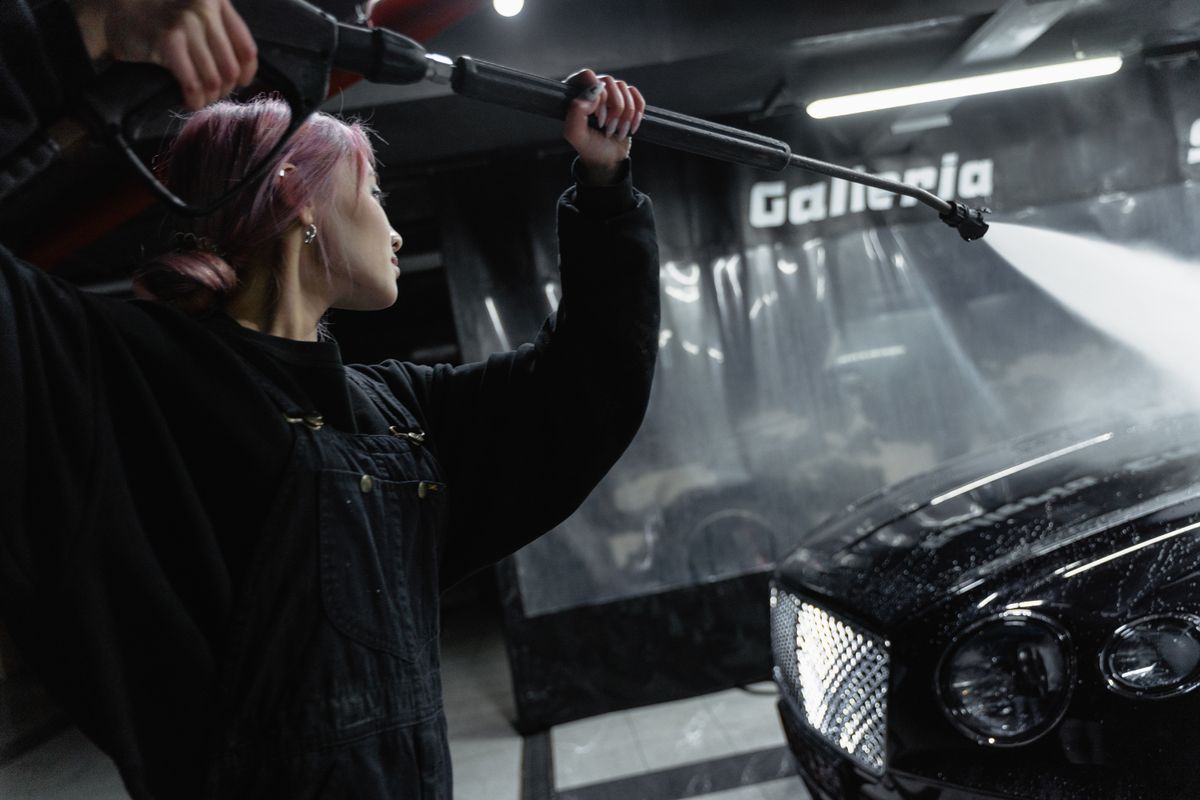
Photo by Tima Miroshnichenko on Pexels
SiO2 Hydrophobic Ceramic Coating (Contact Angle >105°) — Optimal Touchless Efficiency. Surface energy is reduced to ~15-20 mN/m. Air velocity smoothly overcomes minimal pinning forces ($F_{\text{pin}}$), causing water to sheet off in unbroken continuous streams at moderate airflow speeds without leaving residual micro-beads.
Polymer Sealant or Carnauba Wax (Contact Angle ~85°-95°) — High Touchless Efficiency. Requires slightly higher dynamic air pressure to overcome moderate contact angle hysteresis. Maintain a tight 30-degree air nozzle sweep to initiate droplet displacement across larger horizontal panels like bonnets and roofs.
Bare, Uncoated OEM Clear Coat (Contact Angle <50°) — Moderate Touchless Efficiency. High surface energy (~45+ mN/m) causes water to flatten into widespread films. High-velocity air will blow standing water off, but localized micro-droplets may remain due to high liquid-to-solid surface adhesion, requiring a quick targeted pass.
Freshly Applied Ceramic Coating (<24 Hours Cure Time) — Controlled Air Displacement Required. Coating cross-linking is incomplete. High-velocity airflow can be safely used to blow water out of jambs, but maintain a minimum standoff distance of 12-16 inches to avoid distorting wet nano-layers under extreme localized pressure.
The effectiveness of high-velocity air drying depends heavily on the surface energy (measured in millinewtons per meter, mN/m) and the resulting water contact angle of the vehicle's paintwork. Below is an evaluation of how air displacement performs across four distinct paint surface states.
Critical Technique Errors That Compromise Air Drying Efficiency
While touchless air displacement eliminates physical towel contact, poor air blower technique can introduce secondary risks or reduce drying speed. Avoid these four common operational errors:
Infographic: Contact Angle Hysteresis & Water Droplet Shearing
This technical visual breakdown illustrates how surface hydrophobic energy directly dictates the kinetic force required to shear water off automotive clear coats.
Visualizing Water Displacement Patterns Across Vehicle Geometry
Observe how focused air streams interact with complex automotive panels, intricate grilles, and recessed rubber window seals.
Core Scientific Takeaways
- Zero-Contact Paint Safety: Air drying eliminates mechanical towel friction drag, preventing 100% of physical wipe-induced swirl marks.
- Aerodynamic Shear Force: High-velocity air overcomes water droplet pinning forces ($F_{\text{pin}}$) by applying localized kinetic pressure directly to the surface boundary layer.
- Ceramic Coating Synergies: Hydrophobic coatings lower surface energy (down to 15-20 mN/m), increasing water contact angles (>100°) and maximizing air displacement efficiency.
- Crevice Water Evacuation: High-pressure targeted air streams expel trapped water from emblems, side mirrors, door jambs, and lug nuts that towels cannot reach.
- Ergonomic Precision: Compact, dedicated 21V detailing blowers provide superior control compared to clumsy, long-tubed yard blowers, preventing accidental vehicle contact.
Performance Matrix: High-Velocity Air Displacement vs. Microfiber Towels
| Drying Scenario / Vehicle Zone | Touchless High-Velocity Jet Blower | Premium Microfiber Drying Towel | Paint Safety & Kinetic Mechanism |
| --- | --- | --- | --- |
| Horizontal Hood & Roof Panels | Sheets water off in seconds; zero physical surface contact. | Requires dragging heavy wet fabric across clear coat. | Touchless air eliminates micro-friction; towel risks trapping ambient dust. |
| Front Grilles & Intricate Badging | Instantly evacuates recessed pockets and honeycomb mesh. | Cannot reach inner recesses; leaves hidden water traps. | Air pressure clears moisture from un-wipeable interior corners. |
| Side Mirrors & Window Weather Stripping | Clears internal housings so water cannot run down doors later. | Only dries exterior glass; mirror housings bleed water after drying. | Eliminates frustrating post-wash water streaks down clean side doors. |
| Door Jambs & Engine Bays | Clears door sills, hinges, and engine bays rapidly without dirt drag. | Towel collects heavy grease and door hinge grime, ruining fabric. | Touchless displacement leaves grease untouched while blowing clean water out. |
Evaluating how high-velocity touchless drying compares directly against traditional physical towel wiping across key detailing scenarios.
Expert Detailing Tip: Incident Angle Optimization for Sweep Efficiency
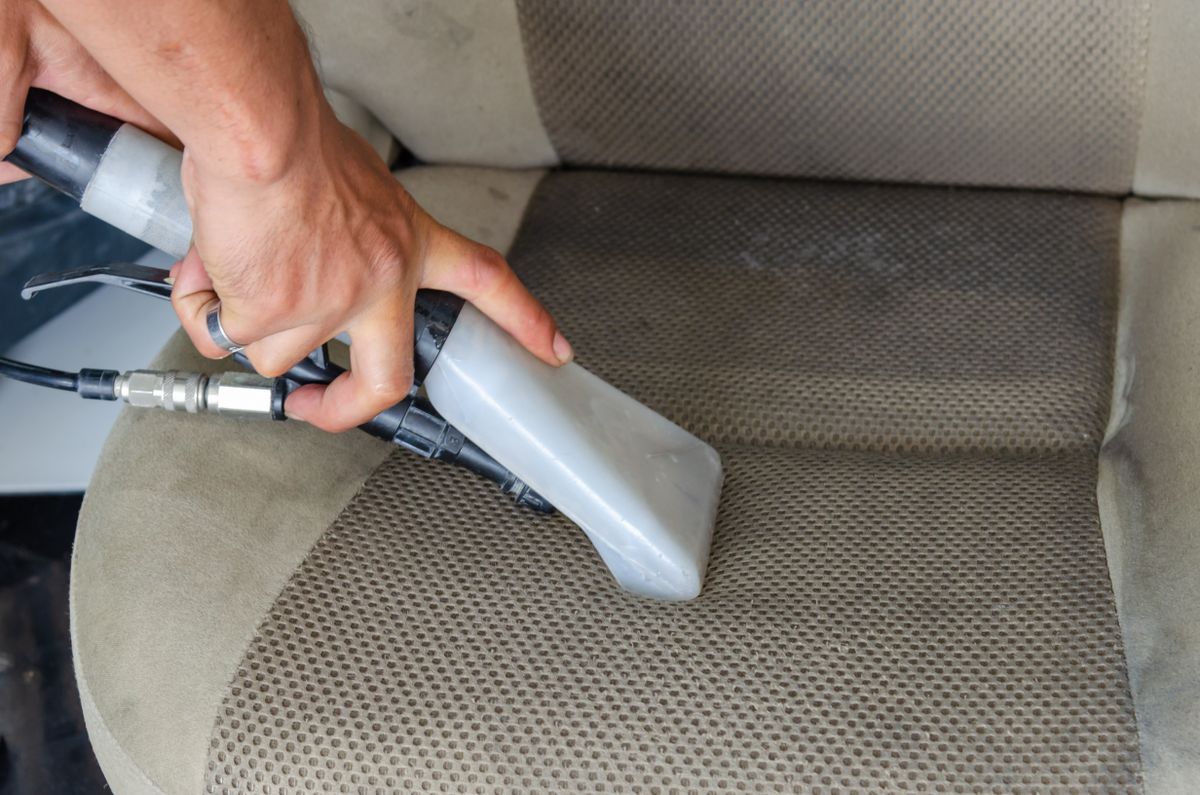
Photo by Khunkorn Laowisit on Pexels
To maximize water displacement speed and prevent droplet shattering, maintain a steady nozzle angle of 30° to 45° relative to the vehicle panel surface, keeping the nozzle tip 4 to 8 inches away.
Always work from top to bottom (Roof -> Glass -> Hood -> Doors -> Wheels). By establishing a moving continuous dynamic air wave, the air stream acts as an invisible squeegee. The continuous sheet of moving air pushes the water bulk downward in one unified front, leaving behind an instantly bone-dry, spot-free surface.
Deep Dive: Paint Physics & Protection Guides
Expand your technical understanding of paint maintenance and scratch prevention with these related educational topics:
- The Ultimate Touchless Car Drying Routine: A step-by-step panel workflow to prevent swirl marks and mineral spotting.
- Touchless Air Drying vs. Microfiber Towels: A deep-dive micro-abrasion analysis comparing clear coat friction wear.
- Understanding Car Dryer Specs: Evaluating voltage, high-velocity airflow, motor specs, and acoustic noise ratings.
Frequently Asked Questions: The Physics of Touchless Car Drying
What air speed (MPH) is actually needed to overcome water adhesion on non-coated paint?
Non-coated clear coats have high surface energy (~45+ mN/m) and low contact angles (~50°), creating tight molecular water adhesion. Overcoming this pinning force requires concentrated, high-velocity airflow producing strong localized dynamic air pressure. Compact detailing blowers designed with focused nozzles accelerate air velocity specifically to shear these flattened water films effectively.
Can high-velocity blowers cause damage to fresh ceramic coatings before they fully cure?
While forced air is completely non-abrasive, high-pressure air streams held closer than 4-6 inches within the initial 12-24 hour cure window could potentially cause liquid distortion in uncured topcoats. Keep a comfortable 12-16 inch standoff distance during early curing phases to ensure safe, touchless drying.
How does a dedicated detailing Jet Blower compare in speed and pressure to standard lawn leaf blowers?
Lawn leaf blowers prioritize volume (CFM) through wide, long tubes designed to move heavy leaves off grass. Dedicated detailing blowers prioritize focused air velocity (MPH) and targeted pressure through compact, short nozzles. This compact form factor allows effortless maneuvering around side mirrors, door jambs, and wheels without the risk of bumping heavy plastic tubes against vehicle paint.
What is the best technique for drying door jambs and badges without pushing water back onto dry panels?
Always execute crevice and jamb blowouts at acute downward angles before sweeping large exterior panels. By blowing out door jambs, badging, and side mirrors early in the drying cycle, displaced crevice water lands on wet surrounding panels, which are then cleanly swept away during final top-to-bottom panel passes.
Technical answers to common questions regarding air displacement velocity, coating safety, and operational techniques.
Essential Gear for Touchless Air Displacement
To execute touchless air displacement effectively, detailers require a portable, high-velocity air tool designed specifically for automotive surfaces.
Actionable Implementation & Next Steps
Your decision: Transition from physical towel drying to touchless high-velocity air displacement to preserve your ceramic coating and eliminate 100% of wipe-induced swirl marks.
Do this next: Switch your detailing workflow to a top-down air displacement routine. Focus high-velocity airflow at a 30° to 45° incident angle across horizontal panels, clearing emblems, side mirrors, and door jambs first.
- Read next: The Ultimate Touchless Car Drying Routine: How to Prevent Swirl Marks and Water Spots
- Read next: Touchless Air Drying vs. Microfiber Towels: Protecting Vehicle Paint from Swirl Marks
Equip your garage with the cordless Jet Blower complete 21V kit for high-velocity, touchless car drying out of the box.
Ready to eliminate towel-induced swirl marks and modernize your car care workflow?
Cover photo by Gratisography on Pexels.