Air Drying vs. Microfiber Towels: Protecting Automotive Clear Coat from Swirl Marks
Should you replace traditional microfiber drying towels with a high-velocity 21V cordless air blower to preserve your vehicle's paint? Yes. Touchless air drying eliminates 100% of mechanical paint contact, rendering it the single safest method to prevent clear coat swirl marks and micro-abrasions. While heavy microfibers absorb standing surface water, trapped ambient grit under towel downforce acts as an abrasive. A 21V high-velocity jet blower displaces water droplets via high-velocity air shear without touching the delicate clear coat layer.
Head-to-Head Comparison: Touchless Air Shear vs. Microfiber Towels by Detailing Scenario
| Detailing Scenario / Vehicle Area | Microfiber Towels (Mechanical Friction) | 21V Cordless Air Blower (Touchless Air Shear) | Paint Safety & Efficiency Verdict |
| --- | --- | --- | --- |
| Soft Clear Coat Paint (Japanese OEM / Custom Refinish) | High Scratch Risk: Microscopic dirt particles trapped between plush microfibers drag across thin resin, creating fine swirl marks. | Zero Scratch Risk: Pure high-velocity air shear lifts and propels standing water without any surface physical contact. | Touchless Air Blower (100% Paint Safety) |
| Complex Crevices (Mirrors, Grilles, Door Jambs, Badges) | Poor Reach: Flat towel surface cannot penetrate narrow gaps, leaving trapped water to drip down and form stubborn mineral spots. | Superior Reach: High-velocity air evacuates trapped moisture from mirror housings, body seams, lug nuts, and trim gaps instantly. | Touchless Air Blower (Complete Crevice Drying) |
| Hydrophobic Surface (Ceramic Coated or Waxed Paint) | Moderate Drag: Heavy wet towels break hydrophobic surface tension slowly, requiring multiple passes that increase friction risk. | Exceptional Velocity: High contact angle allows high-velocity air to force standing water off panels in rapid single sweeps. | Touchless Air Blower (Optimal Hydrophobic Pairing) |
| Un-Coated / Flat Surface Paint Finish | Moderate Risk: Highly absorbent plush towels pick up water, but dragging dry fiber sections generates heavy static drag. | Effective Displacement: Requires closer nozzle passes (4–6 inches), but completely avoids contact-induced micro-marring. | Touchless Air Blower (Prevents Static Friction) |
| Direct Sunlight / High Ambient Temperature Environment | High Water Spot Risk: Drying panel-by-panel with towels takes up to 20 minutes, allowing un-wiped water droplets to bake into clear coat. | Rapid Evacuation: High-velocity air clears full vehicle panels in seconds, evacuating mineral-laden water before sun evaporation occurs. | Touchless Air Blower (Prevents Mineral Spot Etching) |
The table below evaluates performance, paint safety, and physical effort across common detailing scenarios.
Trade-Off Analysis: High-Velocity Air Blowers vs. Premium Microfiber Drying Towels
Photo by Sergei Starostin on Pexels
Pros
- Touchless operation eliminates 100% of towel-induced swirl marks, micro-marring, and clear coat marring.
- Instantly evacuates hidden water trapped behind mirror glass, door seals, tail lights, and window moldings.
- Reduces total vehicle drying time by up to 50% on ceramic-coated or freshly sealed finishes.
- Zero laundry overhead—eliminates detergent washing cycles, fabric softener contamination, and towel storage wear.
- Requires initial hardware investment compared to low-cost entry microfiber towels.
- Requires maintaining charged 21V high-capacity lithium-ion batteries for peak airflow velocity.
- Produces high-velocity air noise requiring hearing protection (ear plugs included in complete kit) during operation.
Pro Detailer Tip: Harnessing Hydrophobic Contact Angles for Instant Air Shearing
To maximize air drying efficiency, understand how surface hydrophobicity dictates air shear physics. When automotive paint is protected with a high-grade ceramic coating or synthetic wax sealant, water droplets form tight spherical beads with high contact angles (>90°). Directing high-velocity airflow from a 21V jet blower at a 30-to-45-degree angle forces these beads to coalesce into continuous water sheets that slide off vertical panels effortlessly. On un-coated paint with low contact angles, maintain a closer nozzle distance (4–6 inches) and sweep from top to bottom (roof down to rocker panels) to push standing water films cleanly off body lines.
Critical Towel Drying Failure Modes That Guarantee Clear Coat Swirl Marks
Traditional wiping methods fail not because detailers lack skill, but because mechanical towel contact introduces structural failure points during water removal.
Drying Method Selection Decision Flowchart
- Is your vehicle paint protected with ceramic coating, sealant, or wax? → Yes: High Surface Hydrophobicity: Proceed to Touchless Air Shearing Evaluation. No: Low Surface Hydrophobicity: Requires Air Shearing with Closer Nozzle Proximity
- Are you attempting to prevent 100% of towel-induced clear coat swirl marks? → Yes: Select 100% Touchless Air Blower Drying (Jet Blower Pack). No: Proceed to Panel Complexity Check
- Does the vehicle feature complex grilles, side mirrors, door jambs, or lug nut wells? → Yes: Primary Air Blower Crevice Evacuation + Optional Plush Microfiber Lower-Rocker Dab. No: Standard Touchless Air Blower Panel Sweeps
Core Takeaways: Paint Hardness, Friction Hazards, and Air Shear Efficiency
- Mechanical friction from towel wiping is the primary root cause of clear coat swirl marks and light micro-marring on modern soft OEM paints.
- High-velocity 21V cordless air blowers utilize kinetic air shear to lift standing surface water without touching clear coat resins.
- Touchless air drying completely eliminates hidden water drip lines from door jambs, side mirrors, trunk seams, and badging.
- Hydrophobic ceramic coatings and wax sealants significantly increase air drying velocity by lowering surface tension water drag.
- A complete kit featuring battery, fast charger, ear plugs, and carrying case provides a portable, zero-scratch drying solution straight out of the box.
Method Selection Matrix: Matching Tools to Vehicle Paint Conditions
Touchless air drying is optimal for vehicle owners who prioritize maximum clear coat safety, time savings, and complete crevice water evacuation.
Best choice for
- 100% Touchless Air Drying (Jet Blower 21V Pack) — High hydrophobic contact angles allow high-velocity air to force 98% of standing water off panels in single passes.
- 100% Touchless Air Drying — Dark clear coats visually display micro-marring instantly; touchless drying eliminates towel drag scratches.
- High-Velocity Cordless Jet Blower — Evacuates water from door jambs, bed rails, trim seams, and badging where towels cannot physically reach.
- You are drying vehicles in noise-restricted indoor spaces without wearing recommended ear protection.
- The vehicle paint is heavily oxidized or contaminated without prior washing, as air will not remove baked-on road tar.
- Hybrid Air-First Strategy — Use 21V air blower for 95% of vehicle drying (crevices, glass, main panels) and follow with a single plush towel dab for lower rocker panels.
Recommended Touchless Drying Solution: The Jet Blower 21V Pack
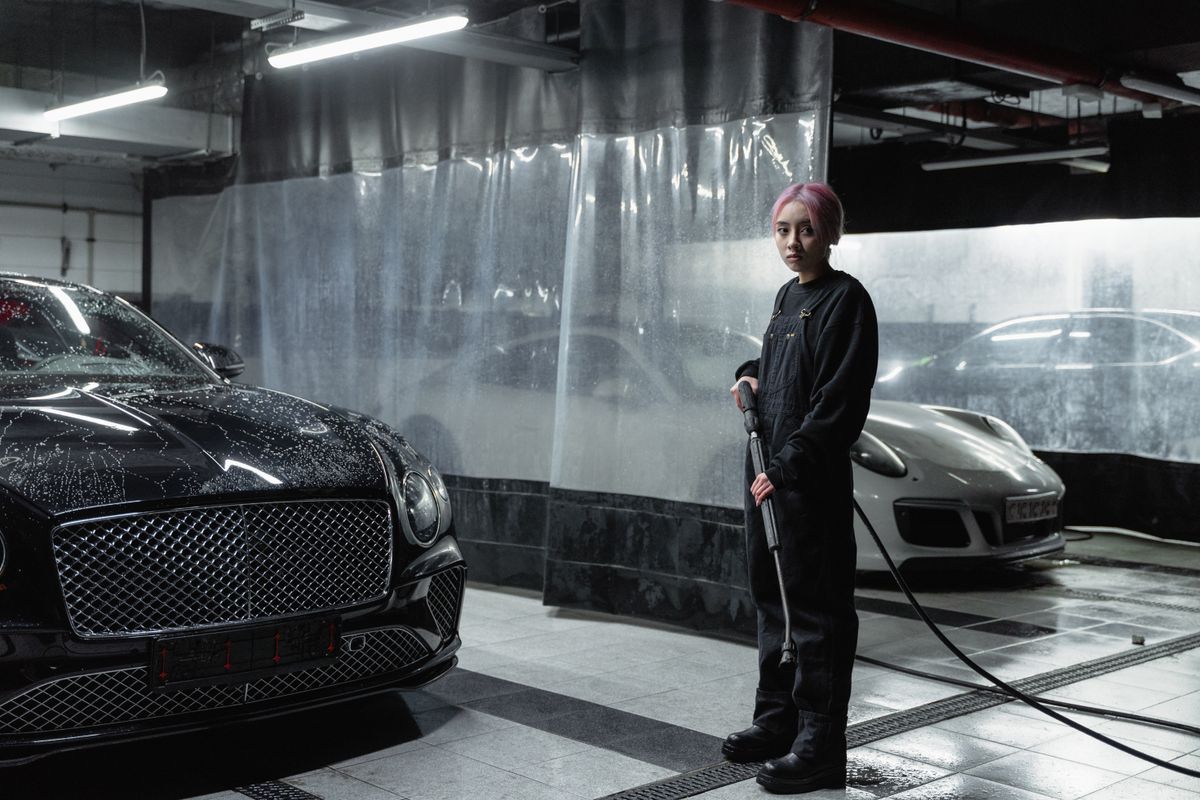
Photo by Tima Miroshnichenko on Pexels
The definitive cordless air displacement system engineered specifically for touchless vehicle drying and crevice moisture evacuation.
Real-World Drying Scenarios: Un-Coated vs. Ceramic-Coated Vehicles
Drying a Ceramic-Coated Full-Size SUV — Set the Jet Blower to high velocity and sweep from top to bottom. The hydrophobic surface coating drops water surface tension, allowing air shear to displace 95-98% of standing droplets off roof, glass, and side panels in under 6 minutes without touching the paint.
Drying Un-Coated OEM Paint with Heavy Crevices — Hold the blower nozzle 4 to 6 inches from the panel surface at a 45-degree angle. First blow out door jamb seals, side mirror housings, window channels, and front grilles. Proceed to sweep body panels from top to bottom, displacing standing surface water without dragging towels across un-waxed paint.
Clearing Water Traps in Engine Bays and Wheel Well Lug Nuts — Direct targeted 21V air bursts into sensitive engine bay electrical connectors, alternator channels, intake shrouds, and wheel lug nut recessed holes. High-velocity air evacuates trapped standing water safely where towel wiping is physically impossible.
How air shear drying performance translates across different paint protection levels in practical garage settings.
To understand why touchless air drying is rapidly replacing traditional drying towels in professional detailing facilities, one must examine the physical contact mechanics occurring at the clear coat boundary layer.
Clear Coat Hardness vs. Environmental Silica
Automotive clear coats consist of polyurethane or acrylic resin layers measuring between 35 to 50 microns in thickness. On the Pencil Hardness Scale, modern factory paint finishes typically measure between 2H and 4H hardness. In contrast, common airborne road dust, silica sand, and brake dust particles register at 7H to 8H on the Mohs Hardness Scale.When a microfiber towel is drawn across a wet vehicle panel, any microscopic silica particle suspended within the standing water droplet or trapped within the towel weave is pressed against the softer clear coat resin. Under normal hand downforce pressure, this physical contact generates shearing stress that exceeds the elastic yield limit of the clear coat, carving sharp V-shaped micro-grooves into the finish. Under sunlight or LED inspection lights, thousands of these parallel micro-grooves reflect light diffusely, producing what detailers recognize as swirl marks and spiderweb marring.
Air Shear Mechanics vs. Mechanical Drag
Touchless air drying replaces physical surface friction with fluid dynamic kinetic shear force. A 21V high-velocity jet blower accelerates ambient air to high speeds, projecting a focused column of kinetic energy onto the wet vehicle surface.When this high-velocity air stream strikes a standing water droplet, it exerts an aerodynamic drag force ($F_d$) that overcomes the liquid's surface adhesion force ($F_a$) to the clear coat. The water droplet lifts off the clear coat boundary layer and travels along the airflow vector without any solid object touching the paint resin. Because no solid material contacts the paint, the friction coefficient remains absolute zero, preventing 100% of towel-induced scratch mechanisms.
Water Spot Etching & Crevice Traps
Beyond direct surface scratching, traditional microfiber wiping suffers from an inherent structural limitation: an inability to evacuate moisture from mechanical body seams. Side mirror housings, door jamb rubber seals, badging contours, tail light gaskets, and lug nut recesses act as water reservoirs during vehicle washing.When a car is dried using only microfiber towels, these internal reservoirs remain filled with mineral-laden wash water. As soon as the vehicle is driven or exposed to ambient wind, trapped water bleeds out across freshly wiped panels. If this water contains dissolved calcium, magnesium, or silica minerals (hard water), direct sunlight causes rapid evaporation, leaving concentrated mineral rings etched deep into the clear coat surface. High-velocity cordless air blowers solve this issue by driving concentrated air streams directly into deep seams, completely clearing trapped moisture before mineral etching can initiate.
Frequently Asked Questions About Air Drying vs. Microfiber Towels
Common questions regarding touchless air drying performance, paint safety, and battery operation.
Action Plan: Transitioning to a Scratch-Free Touchless Detailing Workflow
Your decision: Choose touchless 21V high-velocity air blowing as your primary drying method to protect clear coat paint resins from friction damage.
Do this next: Switch to a high-velocity cordless air blower to clear water from panel seams, mirrors, and body lines before touching paint.
- Read next: How Towel Drying Causes Swirl Marks: The Hidden Physics of Paint Micro-Abrasions
- Read next: The Ultimate Touchless Car Drying Routine: How to Prevent Swirl Marks and Water Spots
Equip your detailing setup with the complete Jet Blower 21V Cordless Pack, including high-capacity battery, fast charger, ear plugs, and rugged hard case.
Follow this practical action plan to eliminate towel-induced clear coat marring and upgrade your vehicle drying workflow.
Deep-Dive Detailing Guides & Technical Resources
Supply cluster context and internal navigation.
Cover photo by Artem Podrez on Pexels.