Car Drying Blower Specifications: Voltage, Airflow & Noise Decoded
As a 21V rule of thumb, effective touchless car drying requires high air velocity (100+ MPH / 10,000+ FPM) driven by at least 21V of direct-current motor power, rather than high air volume (CFM). High velocity creates kinetic shearing force to strip water droplets instantly, while acoustic output exceeding 85 dBA requires hearing protection.
Core Engineering Principles at a Glance
- Voltage Equals Torque: A 21V DC motor delivers 75% higher working torque under continuous pneumatic load than 12V units, preventing RPM drops when pushing dense air columns.
- Velocity Over Volume: Stripping tightly bound water droplets off ceramic or waxed clear coat requires a focused stream exceeding 100 MPH (10,000 FPM). High CFM without velocity merely flattens water droplets.
- Acoustic Reality: Compact high-RPM micro-turbines produce high-frequency acoustic pressure between 90 dBA and 95 dBA at ear level, making included ear plugs essential safety equipment.
- Contactless Paint Protection: Eliminating microfiber towel contact removes 100% of mechanical drag, completely preventing swirl marks, marring, and towel-induced clear coat micro-scratches.
Technical Specification Reference Matrix

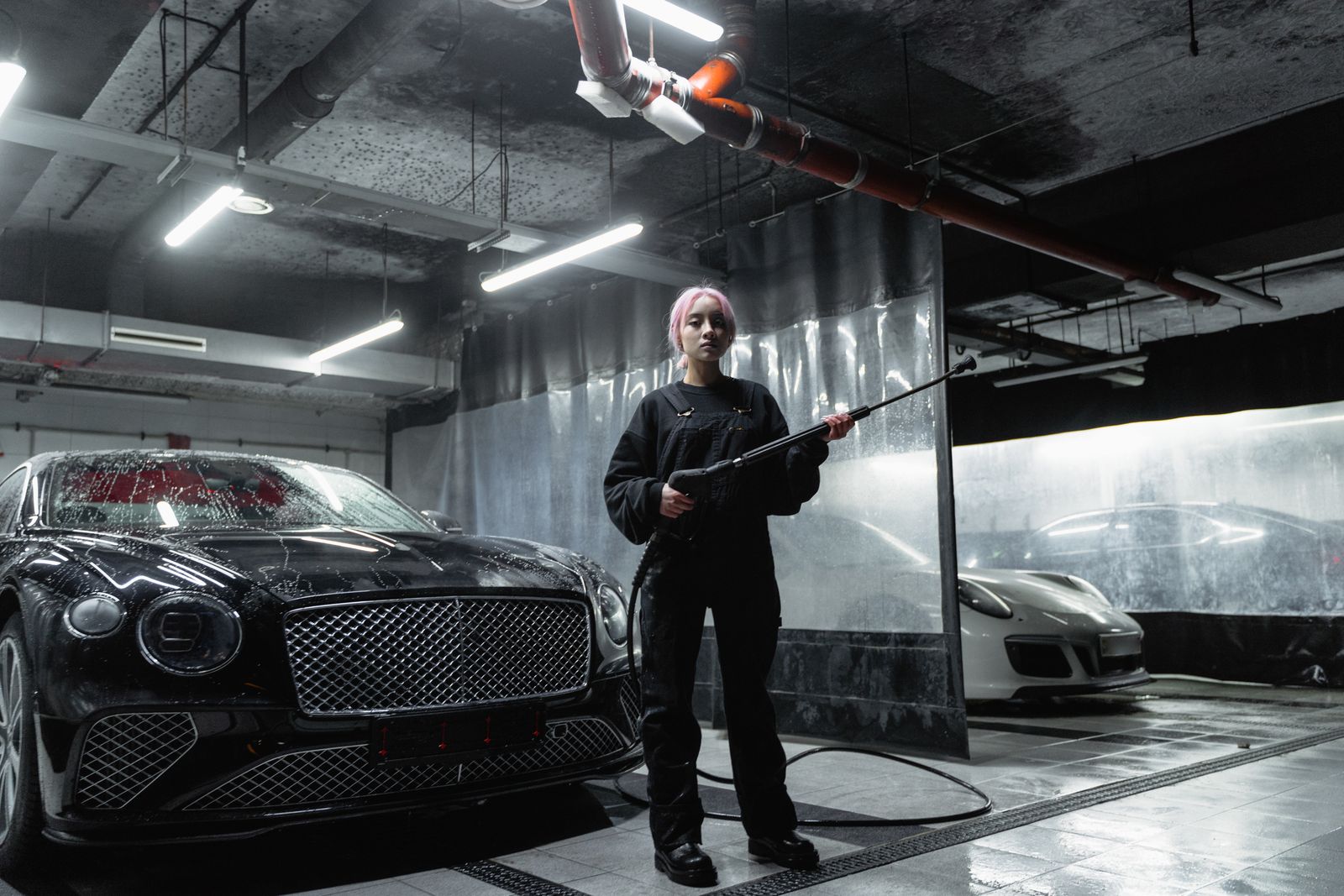
Photo by Sydney Sang on Pexels
| Specification Metric | Minimum Threshold | Optimal Detailing Target | Engineering Impact on Detailing |
| --- | --- | --- | --- |
| Motor Voltage (DC) | 12V - 18V | 21V Lithium-Ion | Sustains turbine RPM under backpressure; reduces current draw (amperage) to limit thermal degradation. |
| Air Velocity (MPH / FPM) | 60 MPH / 5,280 FPM | 100 - 150+ MPH (>10,000 FPM) | Overcomes water surface tension and hydrophobic contact angles to shear droplets off paint panels instantly. |
| Air Volume (CFM) | 30 - 50 CFM | 70 - 110 CFM (Targeted Nozzle) | Provides adequate displacement mass without spreading kinetic force across an unnecessarily wide surface area. |
| Acoustic Pressure (dBA) | 75 dBA | 88 - 95 dBA (PPE Required) | High turbine blade pitch creates elevated dBA; requires certified ear protection for close-proximity use. |
| Unit Weight & Balance | 6.0 lbs | 2.5 - 3.8 lbs | Determines operator fatigue during multi-panel vehicle drying and overhead roof sheet clearing. |
Compare key technical performance thresholds across standard cordless blower metric categories.
Airflow Dynamics: Velocity (MPH) vs. Volume (CFM)
Understanding how nozzle velocity creates kinetic shear force compared to wide volume air displacement.
Pro Tip: Concentrated Nozzles and Kinetic Shearing
To maximize water displacement without overworking your battery, hold the blower nozzle at a 30-degree angle relative to the paint panel and keep a working distance of 3 to 5 inches. Directing air perpendicular to the surface flattens water droplets against the clear coat; an angled high-velocity stream wedges air beneath the droplet's contact angle, breaking surface tension and shearing the water away in continuous sheets.
Choosing the Right Spec Profile for Your Detailing Setup
Your decision: Determine whether your priority is rapid crevice drying and touchless paint protection requiring a high-velocity 21V cordless setup.
Do this next: Evaluate your detailing toolkit specs—prioritize >100 MPH velocity and 21V motor power over high CFM, and ensure acoustic gear is included.
- Read next: 21V Lithium-Ion vs. Lower Voltage Car Blowers: Battery Efficiency & Performance Comparison
- Read next: Cordless 21V vs. Corded Car Drying Blowers: Power, Airflow, and Mobility Compared
Check out the complete Jet Blower Pack (21V battery, charger, ear plugs, and hard case) for scratch-free precision drying.
Follow these steps to align your equipment specifications with your vehicle drying routine.
Spec Matching: Finding the Ideal Blower Configuration
Selecting a car drying blower requires balancing motor voltage (torque under load) and air velocity (kinetic water shearing) against noise output and weight.
Best choice for
- 21V Cordless High-Velocity Jet Blower Complete Kit — Delivers instant high-velocity air displacement in hard-to-reach areas without cumbersome power cords or micro-scratch risk.
- Narrow-nozzle high-FPM compact turbine blower — Focuses kinetic air shear directly into tight seams where standing water causes drip lines and corrosion.
- You expect a high-velocity jet blower to match the silent operation of a manual microfiber towel without wearing hearing protection.
- You rely solely on high CFM ratings intended for moving dry autumn leaves across broad open lawns.
- Corded AC Commercial Air Cannon — Provides unlimited continuous runtime for high-volume detailing shops, though restricted by power cord radius and higher tool weight.
Recommended Cordless High-Velocity Kit
Photo by cottonbro studio on Pexels
The complete all-in-one package engineered specifically for high-velocity vehicle drying, dust clearing, and paint safety.
1. Motor Voltage and Thermal Efficiency (21V DC vs. Lower Voltage)
When evaluating cordless car blowers, motor voltage ($V$) is the foundation of mechanical performance. A 21V DC battery system provides significantly higher electrical potential than standard 12V or 18V light-duty tools. According to Joule's law of heating ($P_{loss} = I^2 R$), driving a turbine motor at lower voltage requires higher electrical current (amperage, $I$) to produce equivalent mechanical output power ($P = V \times I$).By operating at 21V, the motor draws lower current under load. This offers three critical engineering advantages during continuous car drying:
2. Fluid Dynamics: Air Velocity (MPH/FPM) vs. Air Volume (CFM)
The most common marketing trap in car drying tools is conflating Cubic Feet per Minute (CFM) with Miles Per Hour (MPH) or Feet Per Minute (FPM). While lawn leaf blowers advertise 500–700 CFM to move bulk piles of light, dry leaves across open ground, auto detailing requires a completely different fluid dynamics profile.Water adheres to automotive clear coats via molecular surface tension and hydrogen bonding. The contact angle of water droplets on paint determines how tightly those droplets cling:
- Bare Clear Coat: Low contact angle (~60°–70°), creating flat, tightly bonded water sheets.
- Waxed / Sealed Paint: Moderate contact angle (~80°–90°), forming defined beads.
- Ceramic Coated Paint: Hydrophobic high contact angle (>100°–110°), creating elevated spherical beads.
3. Acoustic Dynamics and Decibel Ratings (dBA)
Compact cordless blowers utilize miniaturized high-RPM duct turbines spinning at 30,000 to 100,000+ RPM to compress and accelerate air through tight exit nozzles. This extreme rotational frequency generates distinct sound pressure levels (SPL) typically measuring 90 dBA to 95 dBA at operator ear level (approximately 3 feet distance).Under Occupational Safety and Health Administration (OSHA) standard 1910.95, permissible exposure to 90 dBA noise is limited to 8 hours, but sound energy doubles every 5 dBA increase. At 95 dBA, the safe un-protected exposure time drops significantly. Because the acoustic frequency spectrum of micro-turbines contains sharp upper-midrange pitch, responsible manufacturers include dedicated acoustic ear plugs within the tool kit to protect operator hearing during extended detailing tasks.
Blower Spec Profiles Across Car Care Scenarios
| Detailing Scenario | Required Spec Profile | Primary Performance Metric | Why This Spec Combination Matters |
| --- | --- | --- | --- |
| Drying Large Flat Panels (Hood, Roof, Trunk) | 21V DC / 100+ MPH / 80+ CFM | Kinetic Shearing Velocity | High velocity strips water off broad panels in continuous sheets before water spots can evaporate. |
| Clearing Crevices (Grilles, Side Mirrors, Lug Nuts) | High Velocity (>120 MPH) / Narrow Nozzle | Targeted Airflow Pressure | Forces trapped water out of recessed body seams, preventing post-dry runs down freshly polished paint. |
| Engine Bay & Mechanical Detailing | 21V Cordless / Compact Housing / High FPM | Maneuverability & Air Speed | Safely blows standing water out of alternator housings, coil packs, and sensor plugs without drag cords. |
| Enclosed Garage / Mobile Detailing Bay | Under 3.5 lbs / Included 29dB NRR Ear Protection | Acoustic & Ergonomic Rating | Reduces operator arm strain during roof drying while dampening reverberating acoustic pressure in concrete bays. |
Evaluate how different specification balances perform in real-world auto detailing tasks.
Common Spec Reading Errors to Avoid
Steer clear of these misinterpretations when shopping for automotive drying equipment.
Further Technical Guides & Comparisons
Explore additional technical articles on battery architecture, mobility comparisons, and touchless vehicle maintenance.
Frequently Asked Questions
Answers to crucial engineering and operational questions about car drying blower specifications.
Cover photo by Tima Miroshnichenko on Pexels.