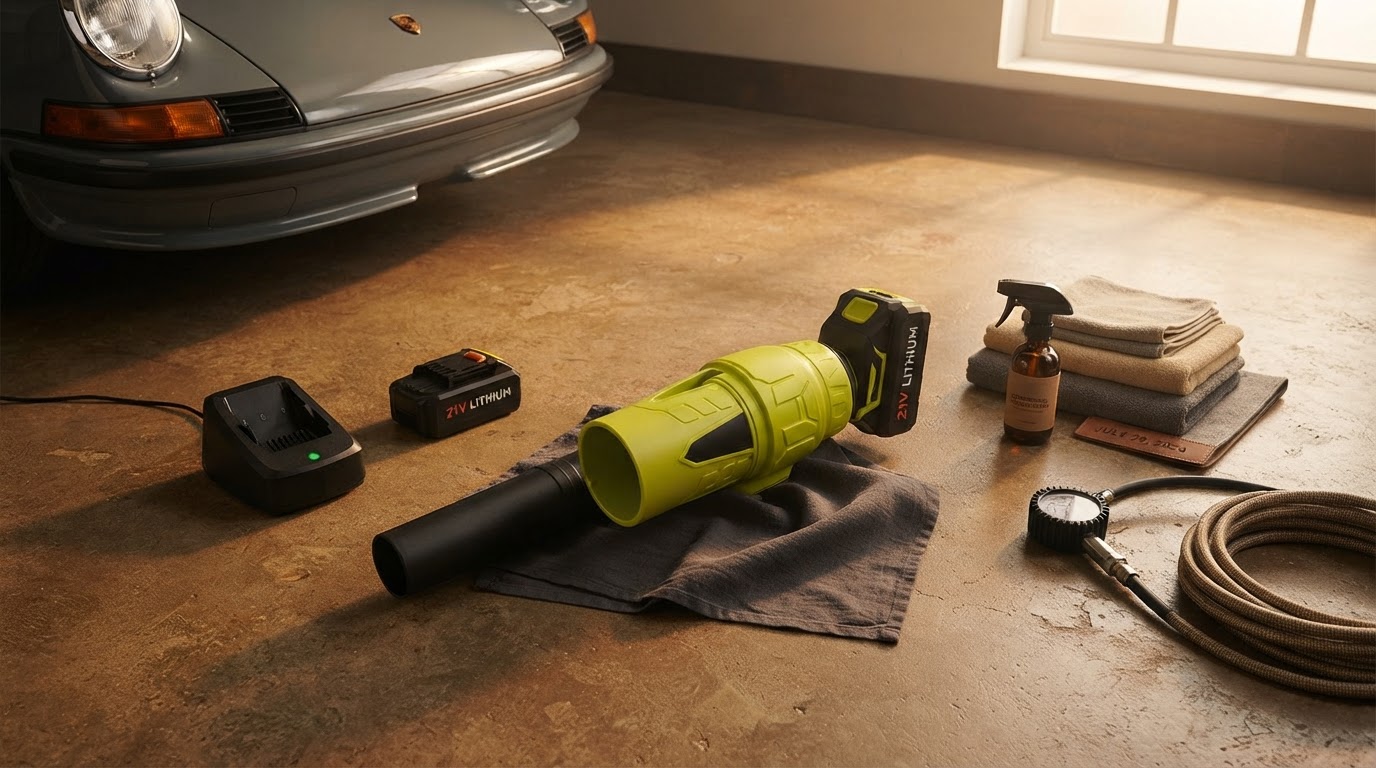
Jet Blower Solutions for Touchless Car Drying
 Maya ChenContributing Editor
July 29, 2026. This analysis examines the technical shift toward using concentrated air streams for automotive surface maintenance. It is written for vehicle owners who prioritize paint integrity over traditional contact-based drying methods.
The Friction Problem in Modern Detailing
The conventional wisdom says that a high-quality microfiber towel is the safest way to dry a vehicle after a wash. However, this ignores the reality of mechanical marring; every time a physical object touches a clear coat, the risk of swirl marks increases. Professional detailers are increasingly moving toward touchless systems to mitigate this risk. According to Suds-Lab, specialized car drying blowers can raise air temperature by up to 25°F above ambient levels, which significantly accelerates the evaporation process compared to natural air drying. While some hobbyists still reach for a standard leaf blower, those tools lack the filtration and concentrated nozzle velocity required for precision work. In enthusiast communities, such as those discussed in Facebook automotive groups, the debate often centers on whether a cordless air blower provides enough sustained force to clear water from complex geometries like honeycomb grills and side mirrors. The data suggests that volume (CFM) matters less than airspeed (MPH) when the goal is shearing water off a hydrophobic ceramic coating. For users who find themselves in different environments, such as managing gear outdoors, the utility of these devices extends further, as noted in our evaluation of the jet blower for camping fire starter applications. The fundamental physics remain the same: controlled, high-velocity air displacement is more efficient than manual absorption.
Jet Blower Performance Metrics

Photo by Renee Razumov on Pexels
Here's the part nobody talks about: most consumer-grade blowers lose their effectiveness the moment the battery dips below 50%. The Jet Blower addresses this through a high-speed brushless motor design that maintains consistent output. Unlike heavy industrial units from brands like MetroVac or EGO, which The Clean Garage notes are often preferred for stationary garage use, the Jet Blower is designed for mobility. Run the math: a standard session requires roughly 8 to 12 minutes of continuous high-velocity air to fully clear a mid-sized sedan. This necessitates a power management system that doesn't throttle performance to save heat. The Jet Blower utilizes a compact turbine housing that maximizes static pressure, allowing the user to force water out of window seals and lug nut pockets where towels cannot reach. This level of precision is a recurring theme in our cordless electric jet blower review, where we analyze how motor RPM translates to real-world drying speed. When you transition from a large-format blower to a compact jet design, you gain the ability to dry a car one-handed, which is critical for maintaining a safe distance from the paintwork. While the jet blower for camping fire starter might focus on oxygen delivery, the automotive application is entirely about surface tension disruption. If the air isn't moving fast enough to break the bond between the water droplet and the wax layer, you are simply pushing moisture around rather than removing it. This is why the Jet Blower's concentrated nozzle is a requirement, not an accessory.
Evaluation Framework for Air Drying Systems

Photo by Jose Ricardo Barraza Morachis on Pexels
Selecting a tool for automotive maintenance requires a departure from the "more power is better" mentality. A tool that is too heavy will lead to fatigue, increasing the likelihood of the nozzle accidentally striking the vehicle's bodywork. A balanced framework for choosing a drying solution must prioritize ergonomics and air purity. I'll change my mind when someone proves that a 15-pound leaf blower is more precise for intricate detailing than a handheld jet unit, but until then, the data favors compact portability. When auditing your current setup, use the following checklist to determine if a Jet Blower fits your workflow:
- Total unit weight: Must be under 3 pounds to ensure one-handed operation during long drying cycles.
- Nozzle construction: Look for tapered designs that increase air velocity without requiring massive power draw.
- Battery compatibility: Ensure the system provides enough runtime for at least two full vehicle dries per charge, a topic explored in depth in our cordless electric jet blower review.
- Storage footprint: The device should be small enough to fit in a side door pocket or a small detailing bag.
- Versatility: Consider if the tool can serve secondary purposes, such as the jet blower for camping fire starter utility, to maximize the return on investment.
- Noise-to-power ratio: High-RPM motors produce significant decibels; the housing must be engineered to dampen high-frequency whine.