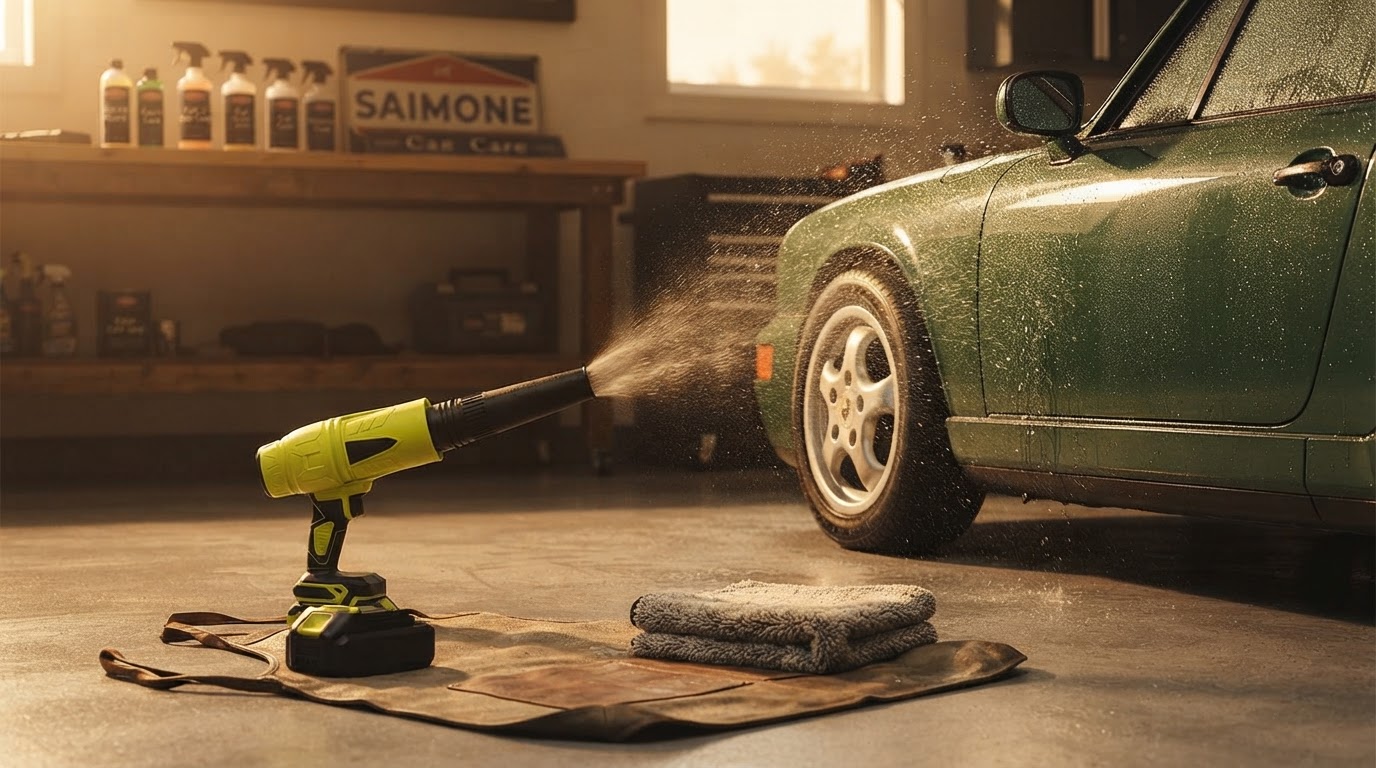
Drying Vehicles with a Jet Blower
 Sam VasquezBuying Guide Lead
September 1, 2026. This guide examines the mechanics and practical application of using a Jet Blower to remove standing water from vehicle surfaces. It is intended for car enthusiasts and professional detailers who need to eliminate water spots without physical contact.
The Problem of Traditional Drying Methods
Traditional drying methods often introduce micro-scratches or "swirl marks" to a vehicle's clear coat. Even the softest microfiber towels can trap grit and drag it across the paint. This is why many are turning to touchless methods. According to Motor Trend, who tested the best air blowers for 2026, compact and precision blowers are becoming a staple in maintenance routines to reach crevices that towels simply cannot access. When water sits in mirror housings, door jambs, and lug nuts, it eventually drips out, leaving unsightly mineral deposits. Using a high-velocity air stream forces water out of these hidden areas before it has a chance to dry.
However, not all air movers are created equal. If you are looking for the best jet dry blower for car detailing, you have to consider the volume of air versus the concentrated pressure. Standard leaf blowers are often too bulky and lack the filtration necessary to ensure you aren't just blasting dust back onto your clean car. In professional detailing circles, as noted in discussions on the Official Detailing Community, users frequently debate the merits of small, handheld jet blowers versus larger industrial units. The primary issue with larger units is maneuverability; trying to dry a roof or a low rocker panel with a six-foot tube is cumbersome and increases the risk of the nozzle hitting the paint. A compact jet dry blower for cars solves this by providing a handheld, high-RPM solution that mimics the concentrated force of a jet engine in a manageable form factor.
Performance and Technical Specifications
Photo by Jose Ricardo Barraza Morachis on Pexels
When we look at the Jet Blower, we are focusing on the intersection of air speed and portability. Unlike the Suds Lab JD Jet Dry Car Blower, which utilizes a 1.5 HP motor and a 20ft cord, the modern Jet Blower emphasizes cordless freedom. While the Suds Lab model offers heated air, which is a significant advantage for evaporation, the physical footprint of a corded unit can be a tripping hazard in a wet wash bay. The Jet Blower relies on sheer velocity. By using a high-speed brushless motor, it generates enough thrust to move water off ceramic-coated surfaces instantly.
If you're on a budget, you might look at something like the Ryobi RY18BLCXA-0, which Motor Trend identified as a solid budget pick. However, between these two, I’d go with the Jet Blower for pure detailing work because the nozzle diameter is optimized for tight gaps. The Jet Blower’s internal turbine is designed to maintain a consistent stream without the surging common in cheaper handheld fans. When you are working on a jet dry blower for cars application, you need that steady pressure to clear out honeycomb grilles. Skip this if you are trying to dry a full-sized commercial van in under five minutes; for large surface areas, you will always want a dedicated high-volume dryer. But for the average sedan or enthusiast vehicle, the Jet Blower provides the precision needed to ensure a spot-free finish. It integrates seamlessly into a workflow that includes the best jet dry blower for car detailing practices, specifically by serving as the primary tool for wheels and intricate trim.
Choosing the Right Drying Tool
Photo by Anastasia Shuraeva on Pexels
Selecting a tool requires a balance between power and safety. You don't just want the most powerful motor; you want a motor that is balanced so it doesn't cause hand fatigue during a 20-minute drying session. When evaluating a jet dry blower for cars, I look at the battery life and the heat dissipation of the unit. High-RPM motors generate significant heat, and if the housing isn't well-ventilated, the tool's lifespan will suffer.
Here’s what I’d actually buy: for a daily driver that isn't ceramic coated, a larger corded unit like the Suds Lab 1.5 HP dryer is efficient because the heated air helps break the surface tension of the water. But for anyone with a coated car or someone who values a minimalist garage setup, the Jet Blower is the superior choice. It fits in a glovebox or a small detailing bag, making it accessible for quick touch-ups after a rainstorm. The best jet dry blower for car detailing is ultimately the one you will actually use every time you wash the car.
Before you make a purchase, run through this checklist:
- Battery Compatibility: Does the blower use a proprietary battery or a standard interface?
- Nozzle Attachments: Are there soft-tip nozzles available to prevent marring if you accidentally touch the paint?
- Weight Distribution: Is the tool top-heavy, or can you hold it comfortably at different angles?
- Noise Levels: High-velocity air is loud; check if you’ll need ear protection for extended use.
- Air Filtration: Does the intake have a screen to prevent debris from being sucked in and shot at your car?
To upgrade your detailing kit with a high-velocity, cordless solution, you can Shop Jet Blower here.