How to Safely Use High-Velocity Air Blowers Without Damaging Clear Coat or Kicking Up Debris
Maintain a 45-degree nozzle angle and a minimum standoff distance of 6 to 12 inches from automotive clear coat. To prevent kicking up driveway dust, direct air downward from roof to rocker panels while keeping nozzle vectors above a 30-degree ground-parallel threshold.
Essential Safety Rules at a Glance
Airflow Safety Parameters by Vehicle Zone

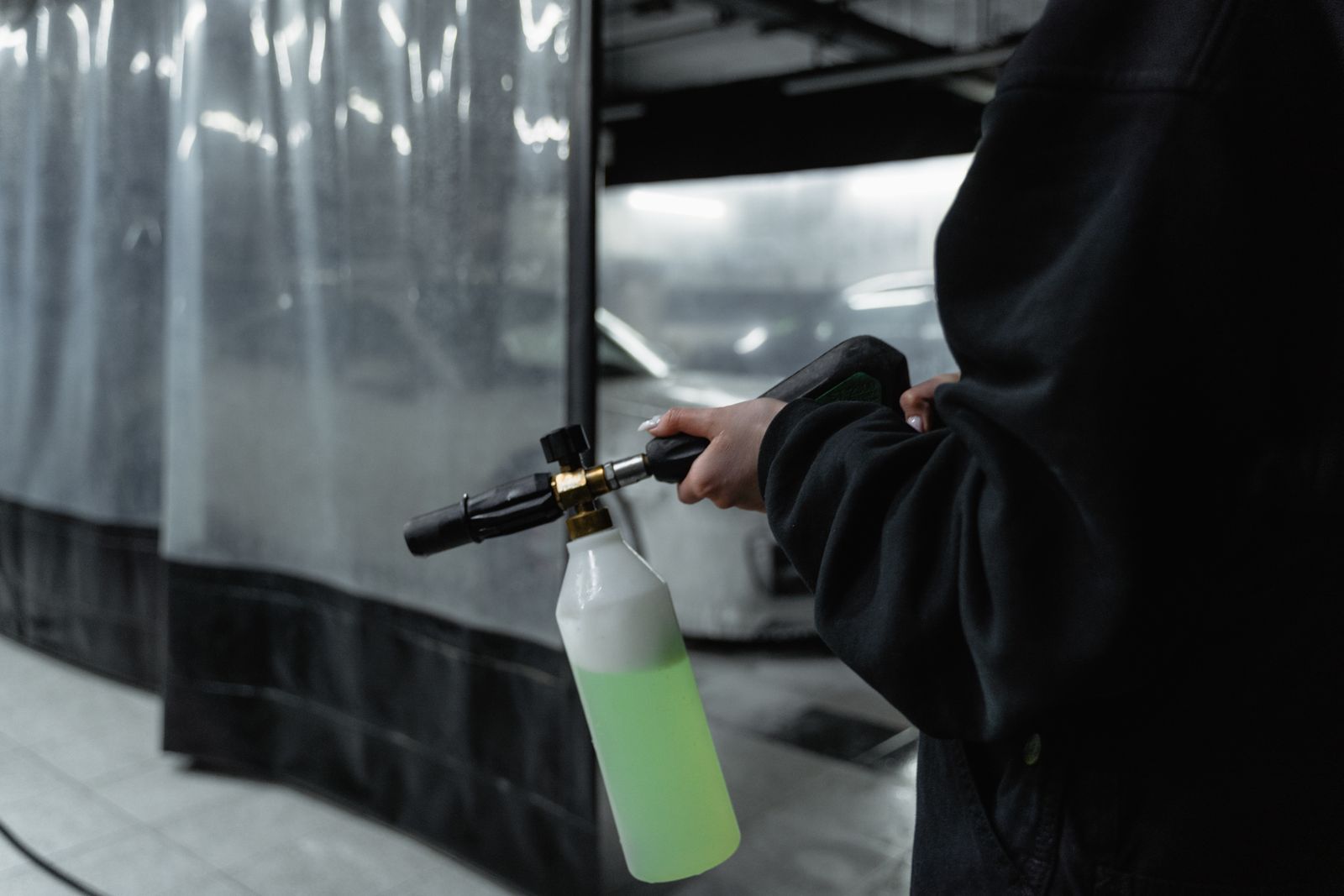
Photo by Anastasia Shuraeva on Pexels
| Vehicle Zone | Safe Standoff Distance | Max Air Shear Angle | Risk Threshold | Recommended Airflow Technique |
| --- | --- | --- | --- | --- |
| Clear Coat Panels (Hood / Roof) | 6 – 10 inches | 45° | Low Risk | Continuous fluid sweeping motion following body line contours. |
| Plastic Badges & Trim | 8 – 12 inches | 30° – 45° | Medium Risk | Short, angled bursts; avoid perpendicular direct blasts into badge backing. |
| Side Mirrors & Door Jambs | 8 – 12 inches | 45° | Medium Risk | Angle airflow outward toward exterior to drive trapped moisture out of housing. |
| Lower Rocker Panels | 10 – 14 inches | 30° (Downward Angle) | High Risk (Ground Dust Kickback) | Sweep downward only; never point nozzle toward ground near panel base. |
| Vinyl Wraps & PPF Edges | 12 – 16 inches | 15° – 30° (Glancing Angle) | High Risk (Edge Lifting) | Glance air across seams; never direct high-velocity streams straight at film seams. |
Different vehicle materials and locations require calibrated distance and angle limits to ensure surface safety and zero moisture entrapment.
Visualizing Water Shearing vs. Ground Debris Zones
Proper airflow angles harness fluid mechanics to lift water off paint cleanly, while establishing strict safety perimeters prevents ground dust contamination.
Pre-Air Drying Safety Protocols
- Inspect vehicle panels to ensure 100% of surface dirt/grit has been thoroughly rinsed off.
- Dampen dry concrete, asphalt, or garage floor within 6 feet of the car to trap loose dust.
- Equip included ear protection before powering on the high-velocity 21V unit.
- Clear all loose pebbles, towels, or debris from the surrounding wash bay ground area.
- Check nozzle attachment to confirm it is securely locked in place before starting airflow.
Pro Detailer Angle Control Technique
Think of the air stream as an invisible squeegee blade. Maintain an identical 45-degree angle relative to the panel, gliding the air wall steadily 6 to 8 inches ahead of the water sheet. If water beads shatter into fine mist rather than rolling off in unified drops, you are holding the blower too close or too perpendicular to the clear coat.
Workflow Transition & Safety Execution
Your decision: Determine your wash environment floor type and adjust your nozzle angle and ground dampening routine accordingly.
Do this next: Lightly mist dry ground surfaces with water, put on ear protection, and maintain a strict 45-degree angle starting from the roof down.
- Read next: How to Stop Water Drips After Car Washing: Complete Crevice Drying Workflow
- Read next: Are Car Drying Blowers Bad for Your Hearing? Decibel Safety & Hearing Protection Guide
Equip yourself with the Jet Blower Complete Kit (21V cordless blower, battery, charger, ear plugs, and hard case) for scratch-free detailing.
Follow this operational sequence to transition safely from wash bay rinsing to touchless air drying.
Choosing the Right Air Drying Workflow for Your Wash Environment
High-velocity air blowers are safest when operated with a 21V cordless tool at a 45-degree incident angle, held 6-12 inches from paint, while avoiding ground-level upward sweeps on unsealed surfaces.
Best choice for
- 45° Rapid Sweep (6-8 in distance) — Hydrophobic surfaces shed water instantly at lower air pressures without thermal or physical tension.
- Standard Top-Down Workflow — Minimal airborne dust risk allows continuous full-power drying across all lower panels.
- Pre-Wetted Floor Protocol — Dampening dry pavement suppresses loose dust, grit, and pollen from circulating into air streams.
- Operating on unwashed or partially rinsed vehicle paint containing residual road grit.
- Blowing air directly upward from gravel or dry dirt ground surfaces within 3 feet of lower body doors.
- Hybrid Air & Ultra-Plush Towel Blotting — Use high-velocity air exclusively for trim, crevices, and wheels, then lightly blot remaining flat panel droplets with a high-GSM plush towel.
Recommended Touchless Air Drying Equipment
Photo by Artem Podrez on Pexels
For effortless, powerful, and safe touchless car drying, select purpose-built cordless jet blowers designed specifically for automotive clear coat applications.
Fluid Dynamics of Contactless Water Displacement
When water rests on automotive clear coat, it forms a surface bond governed by surface tension and contact angle hydrophobic properties. Conventional drying towels remove this water through mechanical absorption, but any microscopic dirt particle trapped between the fabric fibers and the clear coat acts like 2000-grit sandpaper, inflicting fine swirl marks.
High-velocity air blowers replace mechanical friction with kinetic energy. A 21V cordless jet blower generates concentrated air velocity exceeding 100 miles per hour at the nozzle outlet. When directed at a 45-degree angle, this air velocity exerts a directional shear force along the fluid boundary layer. Instead of pressing droplets flat against the paint, kinetic shearing lifts the water bead's leading edge and slides the droplet across the clear coat surface.
Clear Coat Hardness and Standoff Tolerances
Automotive clear coats vary significantly in hardness depending on manufacturer specs, ranging from soft Japanese factory coats (1H to 2H pencil hardness) to rigid German ceramic-clear finishes (3H to 4H). While high-velocity air itself cannot scratch clear coat, maintaining proper standoff distance prevents two key mechanical hazards:
By adhering to a strict 6 to 12-inch standoff limit, the kinetic energy remains concentrated enough to overcome water adhesion while dispersing localized pressure safety margins across delicate paint and trim.
Suppressing Driveway Ground Effect and Dust Kickback
One of the most frequent hazards in outdoor car detailing is ground dust kickback. When high-velocity air hits the lower rocker panels of a car, the air stream continues downward toward the driveway surface. On dry concrete, asphalt, or brick paver floors, this air rebound creates a low-pressure vortex that sweeps up loose sand, fine gravel, and pollen into the air column.
To prevent ground kickback:
- Mist the Bay Floor: Lightly wet the driveway ground within a 6-foot radius of the vehicle before drying.
- Maintain Elevated Angle Vectors: Keep the blower nozzle aimed downward at a maximum 30-degree trajectory when working on lower doors, ensuring airflow deflects away from the vehicle rather than rebounding back onto wet clear coat.
Drying Environment Risk & Angle Mitigation Matrix
| Wash Environment Scenario | Primary Risk Factor | Required Nozzle Angle | Floor Prep Requirement | Recommended Standoff Distance |
| --- | --- | --- | --- | --- |
| Smooth Sealed Epoxy Garage | Low (Controlled Environment) | 45° Shear Angle | Dry sweep or light vacuum before wash. | 6 – 8 inches |
| Wet Asphalt Driveway | Medium (Surface Grit Splatter) | 30° – 45° Angle | Hose down driveway surface prior to drying. | 8 – 10 inches |
| Dry Concrete Outdoor Bay | High (Fine Dust & Pollen Kickback) | 45° Downward Angle | Mandatory water misting wet-down. | 10 – 12 inches |
| Loose Gravel / Dirt Adjacent | Extreme (Airborne Stone Chips) | Strict Top-Only Vectoring | Do not blow air below lower door trim line. | 12 – 16 inches |
Adjust your air-drying operational parameters according to your specific wash bay surface conditions.
Top Air-Drying Hazards That Scratched Clear Coats
Avoid these critical operational errors to preserve paint clarity and extend component longevity.
Further Technical Guides for Detailing Safety
Explore additional technical guides on touchless car drying techniques, hearing protection, and battery maintenance:
- How to Stop Water Drips After Car Washing: Complete Crevice Drying Workflow
- Are Car Drying Blowers Bad for Your Hearing? Decibel Safety & Hearing Protection Guide
- Best Cordless Car Blowers for Detailing: What to Look For in a Touchless Drying Kit
- The Physics of Water Displacement: How High-Velocity Air Protects Ceramic Coatings
Frequently Asked Questions About Air Blower Safety
Clear answers to common operational questions regarding high-velocity car drying blowers.
Action Plan for Scratch-Free Air Drying
Your decision: Choose a high-velocity 21V cordless jet blower system equipped with complete safety gear for touchless detailing.
Do this next: Prep your wash area by wetting the surrounding driveway, wear ear protection, and keep a steady 45-degree angle starting at the roof.
- Read next: How to Stop Water Drips After Car Washing: Complete Crevice Drying Workflow
- Read next: Are Car Drying Blowers Bad for Your Hearing? Decibel Safety & Hearing Protection Guide
Order the Jet Blower Complete Kit (21V cordless blower, battery, charger, ear plugs, and hard case) at https://seeseturbojetblower.com for fast, scratch-free detailing.
Put these touchless drying safety techniques into practice with professional equipment.
Cover photo by Tima Miroshnichenko on Pexels.