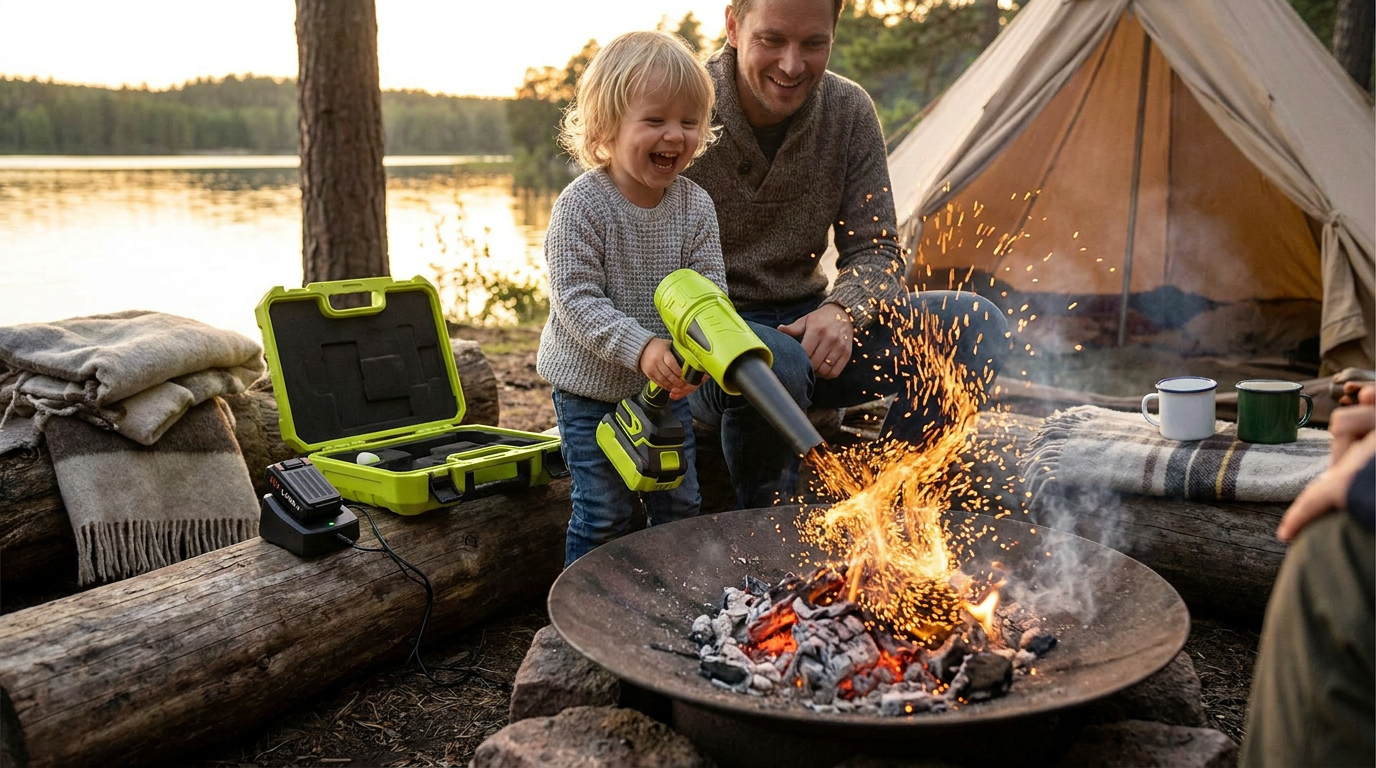
Your Jet Blower Isn't a Bellows. It's a Dehydrator.
 Maya ChenContributing Editor
The conventional wisdom says a jet blower for camping and fire starting is a modern bellows, injecting oxygen to accelerate a fire. The marketing implies a simple equation: more air equals a bigger flame. Here's the part nobody talks about: in damp conditions, its primary function isn't adding oxygen; it's fighting the thermodynamics of water.
A successful fire needs heat, fuel, and oxygen. When fuel is wet, the fire must first expend enormous energy boiling off water before combustion can sustain itself. Water has a high heat of vaporization, requiring approximately 2,260 kilojoules of energy to evaporate one kilogram, according to Georgia State University's HyperPhysics project. A jet blower's high-velocity airflow is a brute-force tool for accelerating this energy-intensive phase change. It effectively outsources the fire's hardest job to a lithium-ion battery, performing a similar function to its role in touchless car drying by physically displacing moisture.
Run the math: A typical jet blower adds about a pound to your pack weight and its battery holds a finite 30-60 watt-hours of energy. This power is spent overcoming the physics of water. For an overlander or car camper, this is a manageable trade-off. For a backpacker, it's an inefficient use of energy compared to the skill of processing wood down to its dry heartwood. The blower is a tool for when environmental moisture is the primary obstacle, not a substitute for finding good fuel.
This makes the jet blower a specialized instrument, not a general-purpose fire starter. The same power that can damage sensitive components during PC cleaning will obliterate a fragile tinder bundle if misapplied. The goal is to introduce a gentle, controlled flow to dry the material, then gradually increase it to feed the established flame. It is this ability to deliver a focused, high-pressure stream—a product of its meticulously engineered motor and a core topic of jet blower maintenance for precision electronics—that distinguishes it from a standard leaf blower, which moves volume but lacks targeted force. Its utility is reviving a rain-soaked coal bed or drying stubborn kindling, not replacing a lighter.
This is not a tool for every camper. It's a moisture-mitigation device for users who understand the physical problem they are solving. I'll change my mind about its niche status when portable batteries offer the energy density to make this thermodynamic brute-forcing a trivial matter. Until then, it's a powerful tool for a specific problem: water.
Is a jet blower good for starting fires in the rain?
Yes, it is an effective tool for drying wet fuel, which is the primary challenge of starting a fire in the rain. It does not create an ignition source. Its high-velocity airflow accelerates the evaporation of water from tinder and kindling, using battery power to do the work the fire would otherwise have to. It helps overcome moisture but still requires a proper fire lay and an ignition source like a lighter or ferro rod.
Can a jet blower replace a lighter or ferro rod?
Photo by Mercedes Matzm on Pexels
No. A jet blower provides high-velocity air; it does not create a spark or flame. It is a secondary tool in a fire-starting system, used to manage oxygen and moisture once an initial flame has been established. You still need a primary ignition source. Relying on a blower without a ferro rod, lighter, or matches means you have a tool to feed a fire but no way to start one.